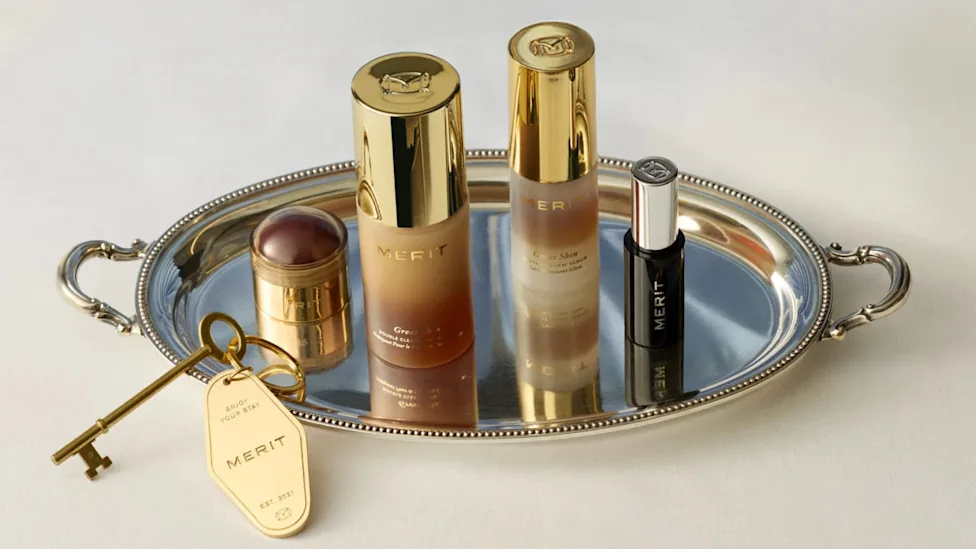
The Ritz-Carlton announced on July 14 an exclusive partnership with MERIT Beauty, marking the skincare and cosmetics brand's first hospitality collaboration of any kind. The rollout brings co-branded beauty carts to select Ritz-Carlton Club Lounges, MERIT-stocked in-room dining kits, turndown amenities paired with skincare samples, and a signature "Minimalist Martini" served alongside a sample of MERIT's Retrospect fragrance at participating properties across the U.S.
It's a modest footprint by hotel-chain standards. But it's a useful marker of where luxury hospitality marketing is heading: brands are building partnerships around products guests can touch, sample, and buy, not just point systems and app perks.
The core takeaway: hospitality brands are increasingly using consumer product partnerships, not loyalty mechanics, to give guests something to physically interact with during their stay, and that interaction is becoming the marketing itself.
What exactly is the Ritz-Carlton and MERIT Beauty partnership?
At select properties, Club Level guests can visit a co-branded beauty cart stocked with MERIT's Great Skin Serum, Great Skin Double Cleanse, Clean Volume Mascara, and Flush Balm. Some locations staff the cart with MERIT beauty educators who walk guests through the products in person. In-room dining offers curated MERIT bundles in a custom pouch, and turndown service at participating hotels includes chocolates alongside skincare samples.
"MERIT shares our belief that true luxury is found in the details," said George Fleck, senior vice president and global brand leader for The Ritz-Carlton, in the July 14 announcement. "This collaboration allows us to introduce exclusive, thoughtfully designed experiences, especially within our Ritz-Carlton Club Lounges, where guests can engage with the brand in a way that feels personal, elevated, and distinctly Ritz-Carlton."
Aila Morin, chief marketing officer of MERIT Beauty, framed the deal as a natural extension for a brand built around portability: "MERIT creates products that are meant to live with you, especially when you're on the go, so partnering in the hospitality space is a natural step for us, and who better to partner with than an iconic brand like The Ritz-Carlton."
Why are hospitality brands leaning into wellness and beauty partnerships now?
The timing tracks with where consumer spending is actually going. The Global Wellness Institute's 2025 Global Wellness Economy Monitor, released in November, put the global wellness economy at $6.8 trillion and projected it to reach $9.8 trillion by 2029. Wellness tourism is one of the faster-growing slices of that figure, and hotel groups are watching guests research a property's wellness credentials before they book a room, not after.
For a brand like The Ritz-Carlton, aligning with a culturally credible, fast-growing beauty label isn't a side project. It's a hedge against a guest expectation that luxury now includes visible wellness signaling, not just thread count.
A different model than the typical hotel collaboration
Most hotel brand tie-ins run through loyalty programs or one-off influencer stays. This one is different. It embeds MERIT into physical touchpoints a guest already passes through during a stay: the lounge, the turndown service, the in-room dining menu. It behaves more like retail merchandising than a media buy. Nothing here asks a guest to click a link or scan a code. It asks them to notice a product in a moment when they're already relaxed and paying attention.
What should marketers take from this?
Three things travel beyond the hotel industry. First, exclusivity does real work: MERIT's "first-ever hospitality partnership" framing signals scarcity and lends the collaboration weight it wouldn't have as a generic product placement. Second, physical touchpoints are outperforming digital ones for brand discovery in premium hospitality right now, at least as a complement to social strategy. Third, both companies put a senior executive on the record with a specific, on-brand quote, which signals to press and partners that this is a strategic bet, not a one-off promotional stunt.
For hospitality, wellness, and lifestyle brands watching from the sidelines, the lesson isn't to copy the exact mechanics. It's to ask where your customer already spends unhurried attention, and whether a partner brand could occupy that moment better than another paid ad could.
One Media Society is a Miami-based creative marketing agency working with hospitality and wellness brands across South Florida and beyond, and partnerships like this one are exactly the kind of case study we study closely when we're building campaigns that meet guests where they're already paying attention, not where an ad happens to find them.